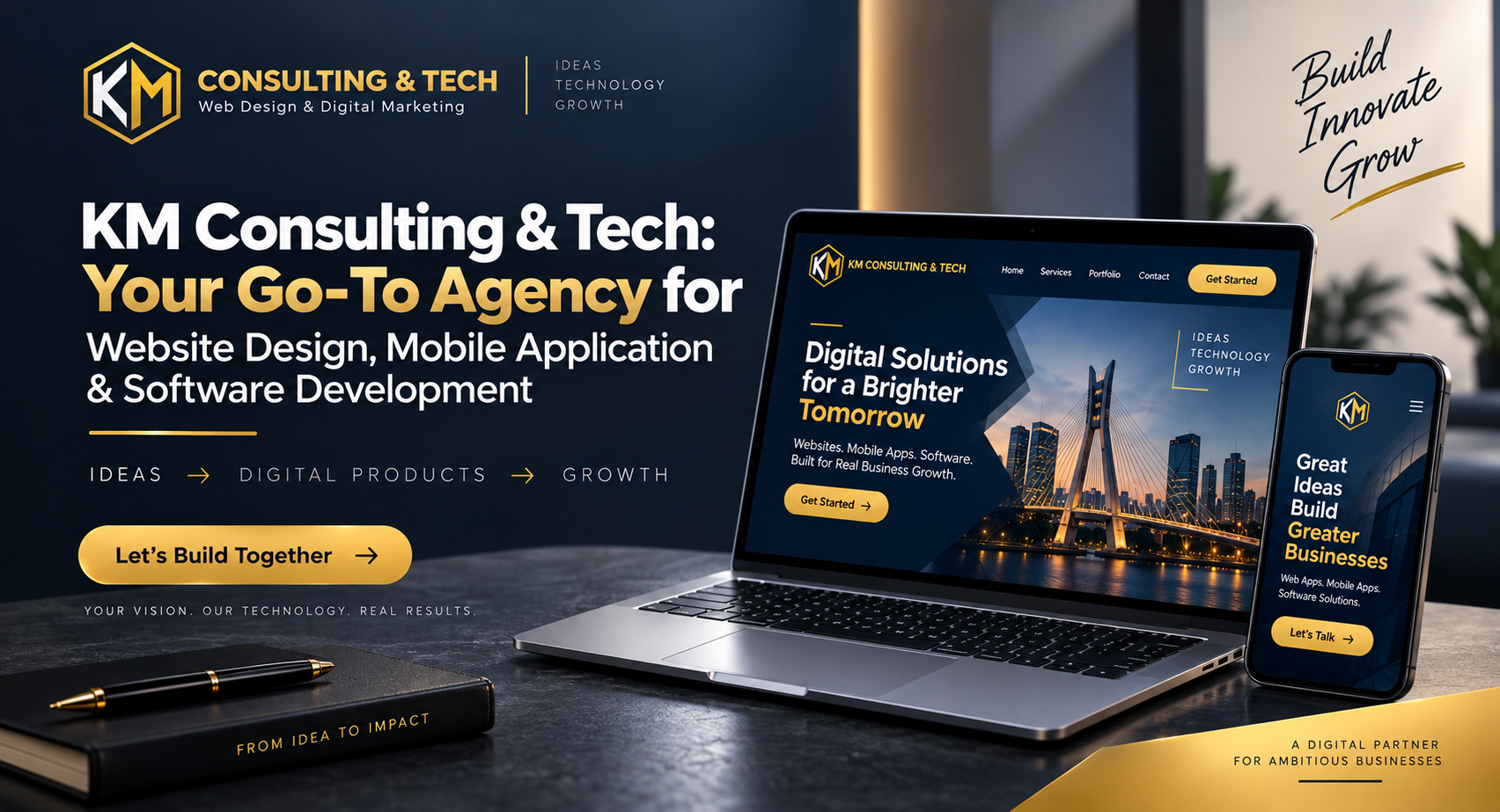
In today’s digital economy, having the right technology partner can be the difference between an idea that struggles to gain traction and a digital product that becomes a successful business. Whether you need a professional website, a mobile application, or custom software to transform your business operations, KM Consulting & Tech is your go-to technology development partner contact us today – +2347039340610 We don’t just build digital products. We help businesses turn ideas into working, scalable solutions. From the first conversation to design, development, testing, deployment, and launch, KM Consulting & Tech provides an end-to-end approach designed around the specific needs of each client. Website Design That Goes Beyond Appearance A business website should be more than an online brochure. It should communicate your brand, build credibility, attract customers, generate leads, and support your business objectives. At KM Consulting & Tech, we design and develop modern, responsive, user-friendly websites for businesses, organisations, startups, entrepreneurs, and professionals. Whether you need a corporate website, e-commerce platform, marketplace, booking platform, consulting website, portfolio, or custom web application, we focus on creating experiences that look professional while serving a clear business purpose. Mobile Applications Built Around Real Business Ideas Have an app idea? We can help turn it into a functioning product. Our mobile application development services cover the journey from concept and feature planning to UI/UX design, development, testing, deployment, and continuous improvement. We understand that developing an app is not simply about creating screens and connecting APIs. A successful application needs to solve a real problem, provide a good user experience, and have a sustainable business model. That is why we approach mobile development with both technology and business strategy in mind. Custom Software for Businesses That Want to Work Smarter Every business has unique processes and challenges. Sometimes off-the-shelf software simply isn’t enough. KM Consulting & Tech develops custom software solutions that help businesses automate processes, manage operations, connect teams, serve customers, collect data, and scale efficiently. From business management platforms and SaaS products to marketplaces, dashboards, portals, APIs, and integrated systems, we build technology around the way your business actually works. An Experienced Team with practical knowledge across different Business Sectors One of the unique strengths of KM Consulting & Tech is our team structure. Our team consists of experienced freelancers and independent specialists who come together as a collaborative technology team. We have a mix of skilled professionals for each project, ensuring you get the expertise, flexibility, and efficiency your project requires. This gives our clients access to different areas of expertise while allowing us to remain flexible and cost-effective. The result is simple: you get a team built around your project rather than a project forced to fit a rigid agency structure. Affordable, Practical and Business-Focused We understand that businesses, particularly startups and growing companies,have to make every naira count. Our approach is therefore focused on delivering value, not unnecessary complexity. Where appropriate, we help clients identify the essential features required to launch an MVP, prioritise development, and build progressively as the business grows. Our goal isn’t to sell you technology you don’t need. Our goal is to help you build the technology that makes sense for your business. Communication Is Part of Our Development Process Great development requires more than great code. It requires communication. We keep clients involved throughout the project, explaining technical decisions in straightforward language and providing opportunities for feedback during design and development. You should always understand what is being built, why it is being built, and what happens next. From Idea to Launch and Beyond Perhaps the biggest reason businesses choose KM Consulting & Tech is our ability to work with clients from the very beginning of an idea. You may have nothing more than a concept written in a notebook. You may have a business model but no technology. Or you may already have an existing platform that needs improvement. Wherever you are starting from, we can help you move forward. Idea → Strategy → UI/UX → Development → Testing → Deployment → Launch → Growth. And because our perspective is not limited to development, we can help identify opportunities, challenges, features, integrations, and improvements that can make the final product more commercially useful. More Than Developers. A Technology Partner. At KM Consulting & Tech, we believe the best technology solutions come from understanding the business behind them. Our entrepreneurial experience gives us a different perspective. We understand that a website, mobile application, or software platform is ultimately an investment. It needs to contribute to the client’s objectives; not simply exist because technology makes it possible. That is why we combine technology, creativity, business thinking, affordability, communication, and execution to help our clients bring their ideas to life. Whether you’re a startup looking to launch your first digital product, an established company looking to modernise its operations, or an entrepreneur with the next big idea, KM Consulting & Tech is ready to work with you. Your Idea. Our Expertise. One Digital Solution. If you’re searching for a reliable partner for website design, mobile application development, or custom software development, KM Consulting & Tech provides the experience, flexibility, and business-oriented approach to take your project from concept to launch. Don’t just build technology. Build something that moves your business forward. KM Consulting & Tech – From Idea to Launch.
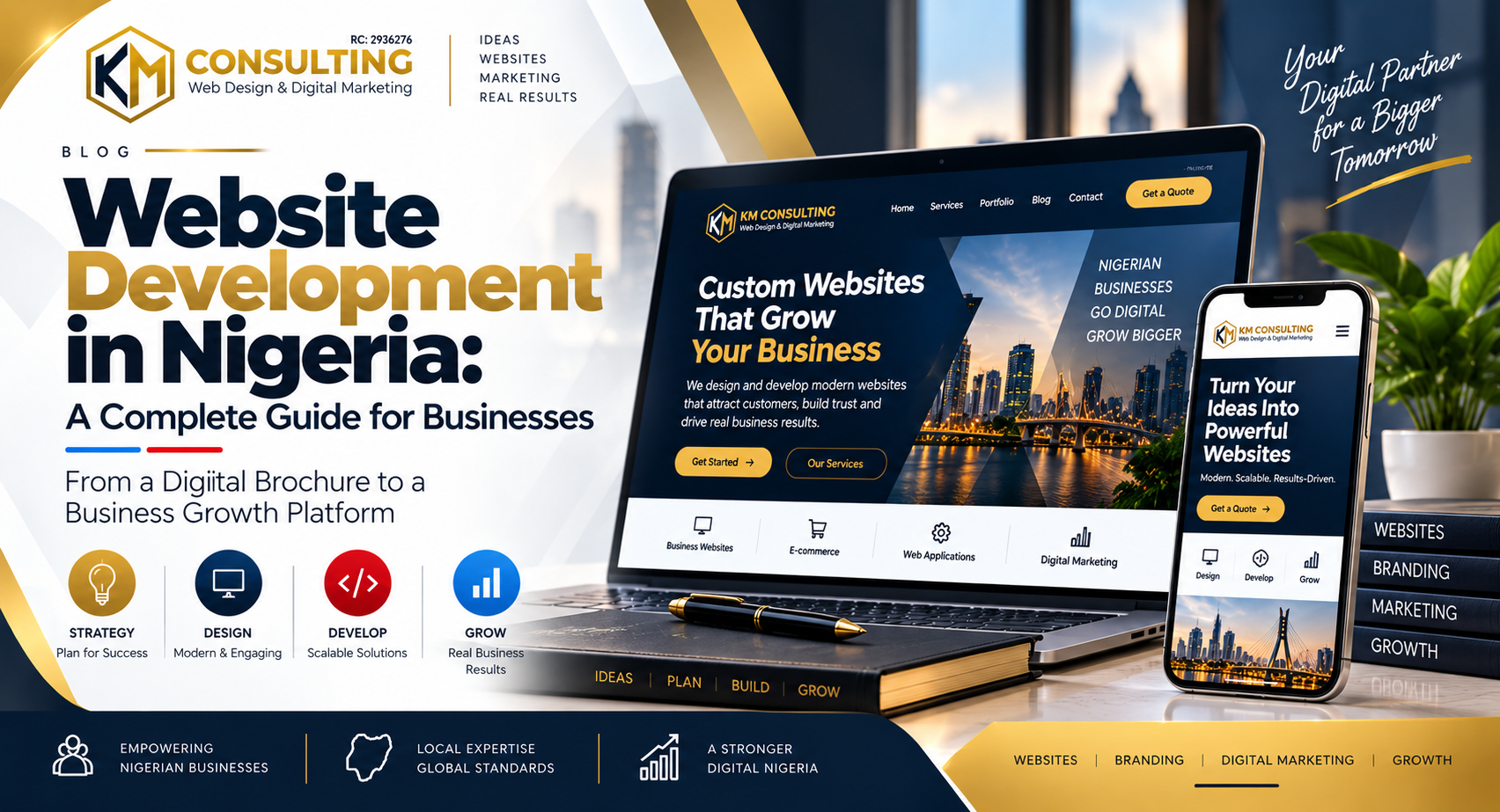
Website Development in Nigeria: A Complete Guide for Businesses From a Digital Brochure to a Business Growth Platform
A website is often the first digital asset a potential customer encounters. But in 2026, a business website should be more than a collection of pages containing a company description and telephone number. A well-designed website can function as: A sales channel Lead-generation platform Booking system E-commerce storefront Customer-support channel Content platform Recruitment tool Business information hub Digital brand experience The question is therefore no longer simply: “Does your business have a website?” The better question is: “What is your website supposed to achieve?” Types of Business Websites Corporate Website Suitable for companies that need to establish credibility and communicate their services. Typical pages include: Home About Services Industries Portfolio Blog Contact E-commerce Website Designed for businesses selling products online. It may include: Product catalogue Search Cart Checkout Payment Customer accounts Order management Inventory Marketplace A multi-vendor system involving customers, vendors and administrators. Web Application A web application can provide functionality beyond normal informational pages. Examples include: Dashboards Booking systems Portals SaaS products Management systems The Importance of Strategy Before development begins, a website should have a clear purpose. For example: Goal: Generate leads. Then the website needs: Strong service pages Clear CTAs Contact forms WhatsApp integration Case studies Testimonials SEO content If the goal is e-commerce, the architecture changes. If the goal is a membership platform, it changes again. User Experience Visitors should quickly understand: Who are you? What do you offer? Who do you serve? Why should they trust you? What should they do next? Good UX reduces cognitive friction. Navigation should be predictable. Content should be readable. Buttons should be obvious. Forms should not be unnecessarily complicated. The mobile experience should receive serious attention because many users will access the website through smartphones. Mobile Responsiveness A website should work properly across: Smartphones Tablets Laptops Desktop monitors Responsive design should not simply mean shrinking desktop content. The experience should be deliberately designed for smaller screens. Menus may change. Content hierarchy may change. Images may change. Buttons may need larger touch targets. CMS and Administration Businesses often need the ability to update their own websites. A content management system can allow administrators to manage: Blog posts Pages Images Products Services Team members Testimonials Events Resources This can significantly reduce dependence on developers for everyday content updates. SEO A beautiful website that nobody finds can become an expensive brochure. SEO should therefore be considered during development. Important areas include: Page titles Meta descriptions Heading structure URLs Internal linking Image optimisation Page speed Structured data Sitemap Search indexing Content Service pages should target relevant commercial search terms naturally. For example: Software Development Company Nigeria is much more commercially meaningful than a generic article about software. Website Security Security should also be planned. Depending on the system, this can include: HTTPS Secure authentication Access controls Backups Secure forms Plugin management Server security Monitoring For websites processing customer information or payments, the security requirements become more significant. Integrations Modern websites frequently integrate with other systems. Examples include: Payment gateways CRM Email marketing WhatsApp Analytics Social media Booking systems Maps ERP systems APIs Integration requirements should be identified before development. Website Development Cost The cost can vary significantly. A basic corporate website may require only a handful of pages. A larger platform could involve: CMS Blog Resource centre Payment Membership Admin dashboard API integrations Search User accounts The right budget therefore depends on the scope. The KM Consulting Approach At KM Consulting & Tech, website development should be treated as digital product development rather than simply page creation. The process can include: Discovery → Strategy → UX → UI → Development → CMS → Integrations → SEO → Testing → Deployment. This creates a website capable of supporting the business beyond launch. Final Thoughts Your website should answer one fundamental question: What business outcome is this website designed to produce? If the answer is leads, design for leads. If the answer is sales, design for sales. If the answer is bookings, design for bookings. If the answer is authority, design for credibility. The strongest websites connect design, technology and business objectives. A website should not merely represent your business online. It should help your business operate and grow. Contact us for your web design +2347039340610
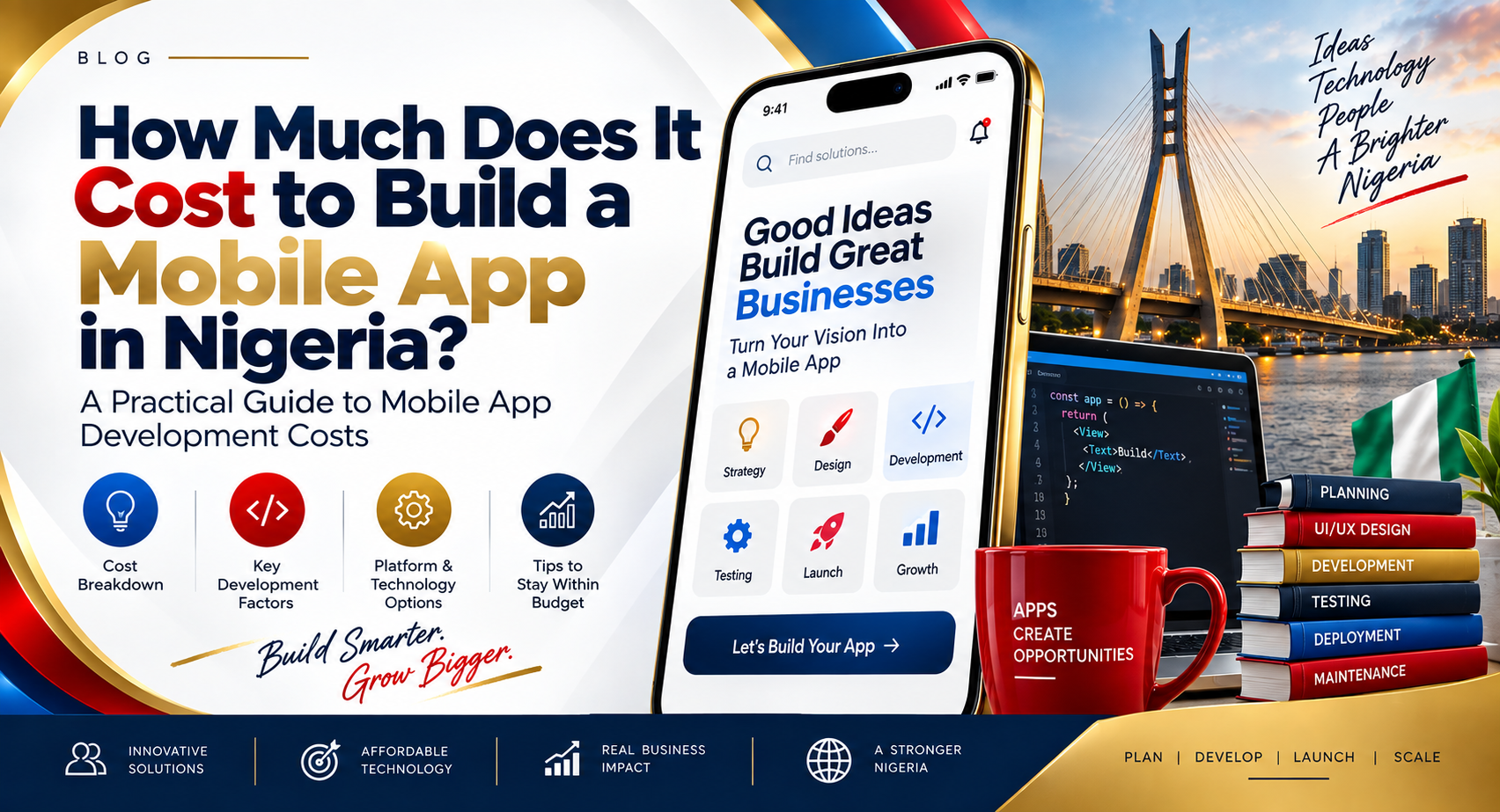
How Much Does It Cost to Build a Mobile App in Nigeria? A Practical Guide to Mobile App Development Costs
One of the first questions entrepreneurs ask when they decide to build an application is: “How much will it cost?” It sounds like a simple question. It isn’t. There is no universal price for mobile app development because a mobile application can be anything from a simple informational app to a sophisticated platform with payments, real-time tracking, artificial intelligence, multiple user roles and complex backend infrastructure. The cost therefore depends on what you are building. Before you forget, at KM Consulting & Tech, we build apps to meet up to global standards +2347039340610 The First Mistake: Pricing the App Before Defining It Imagine two people say: “I want a mobile app.” The first person wants: Five screens Company information Contact form Push notifications The second wants: Customer app Vendor app Admin dashboard Payments KYC GPS Chat Reviews Subscriptions Analytics They are both asking for a “mobile app.” But technically, commercially and financially, they are completely different projects. This is why professional development should begin with product discovery and requirements. Major Factors Affecting Cost 1. Number of Platforms Are you building: Android only? iOS only? Android and iOS? Mobile and web? Cross-platform frameworks can help businesses deploy applications efficiently across platforms, but architecture and testing still need to be planned carefully. 2. UI/UX Complexity A basic application may have relatively straightforward interfaces. A sophisticated platform may require: User research Wireframes Prototypes Design systems Animations Complex dashboards Multiple states Accessibility considerations The more complex the user experience, the greater the design and development effort. 3. Backend The mobile app is only one part of the system. Most serious applications require backend infrastructure. This may include: Authentication User management Database APIs File storage Notifications Business logic Reporting Administration An app without a properly designed backend can become difficult to maintain. Basic App A basic business app may contain: Home About Services Contact Notifications Simple user account This type of project can be relatively straightforward. Medium-Complexity Application A medium application could include: User accounts Profiles Search Booking Payments Notifications Reviews Admin dashboard At this level, backend architecture becomes much more important. Complex Platform A complex application could involve: Multiple user roles Vendor management Payments Wallets KYC GPS Real-time tracking Chat Subscription systems Analytics AI Third-party integrations This is no longer simply “an app.” It is a digital platform. Mobile App Development Cost Structure A useful way to think about the budget is by components. Discovery Understanding: Users Business model Requirements Competition Workflows UI/UX Designing: User flows Wireframes Interfaces Prototype Design system Frontend Development Building the mobile interfaces. Backend Development Building: Database APIs Authentication Business logic Administration Building the dashboard used by the business. Integrations Examples include: Payment gateways Maps SMS Email Identity verification Analytics Cloud services Testing Testing should cover: Functional behaviour Devices Performance Security User experience Deployment The application then needs to be prepared for app stores and production infrastructure. Why Very Cheap Quotes Can Become Expensive A low initial quotation can be attractive. But if important requirements are excluded, the client may later pay for: Rebuilding architecture Additional development Security fixes Missing APIs Poor database design UI redesign App-store corrections Performance improvements The important question isn’t: “Who gives me the cheapest quote?” It is: “What exactly am I getting for the quoted amount?” How to Reduce Development Cost There are legitimate ways to reduce cost. Start with an MVP. Don’t build 100 features before validating the product. Use a cross-platform strategy where appropriate. This can reduce duplicated frontend development. Reuse infrastructure. Authentication, notifications, analytics and other common components can be structured efficiently. Prioritise. Classify features as: Must have Should have Could have Later Document requirements. A clear PRD reduces ambiguity and change requests. What Should Be in Your Development Quote? A professional proposal should identify: Scope Number of platforms Number of screens Backend Admin dashboard Integrations Testing Deployment Timeline Maintenance Third-party costs Payment terms This allows the client to compare proposals based on scope rather than price alone. The KM Consulting Approach At KM Consulting & Tech, mobile application projects can be approached as complete digital-product engagements. That means considering: Business → UX → Technology → Development → Testing → Deployment → Growth. This approach is particularly important for startups because the first version of the product needs to be technically sustainable while remaining focused enough to launch. Final Thoughts There is no meaningful universal answer to “How much does an app cost?” The better question is: “What does it take to build the specific product I need?” Once the requirements are clear, the development team can estimate the work much more accurately. For Nigerian businesses considering mobile applications, the smartest starting point is therefore not a price list. It is a product specification. Define the product. Define the users. Define the features. Define the architecture. Then price the development.
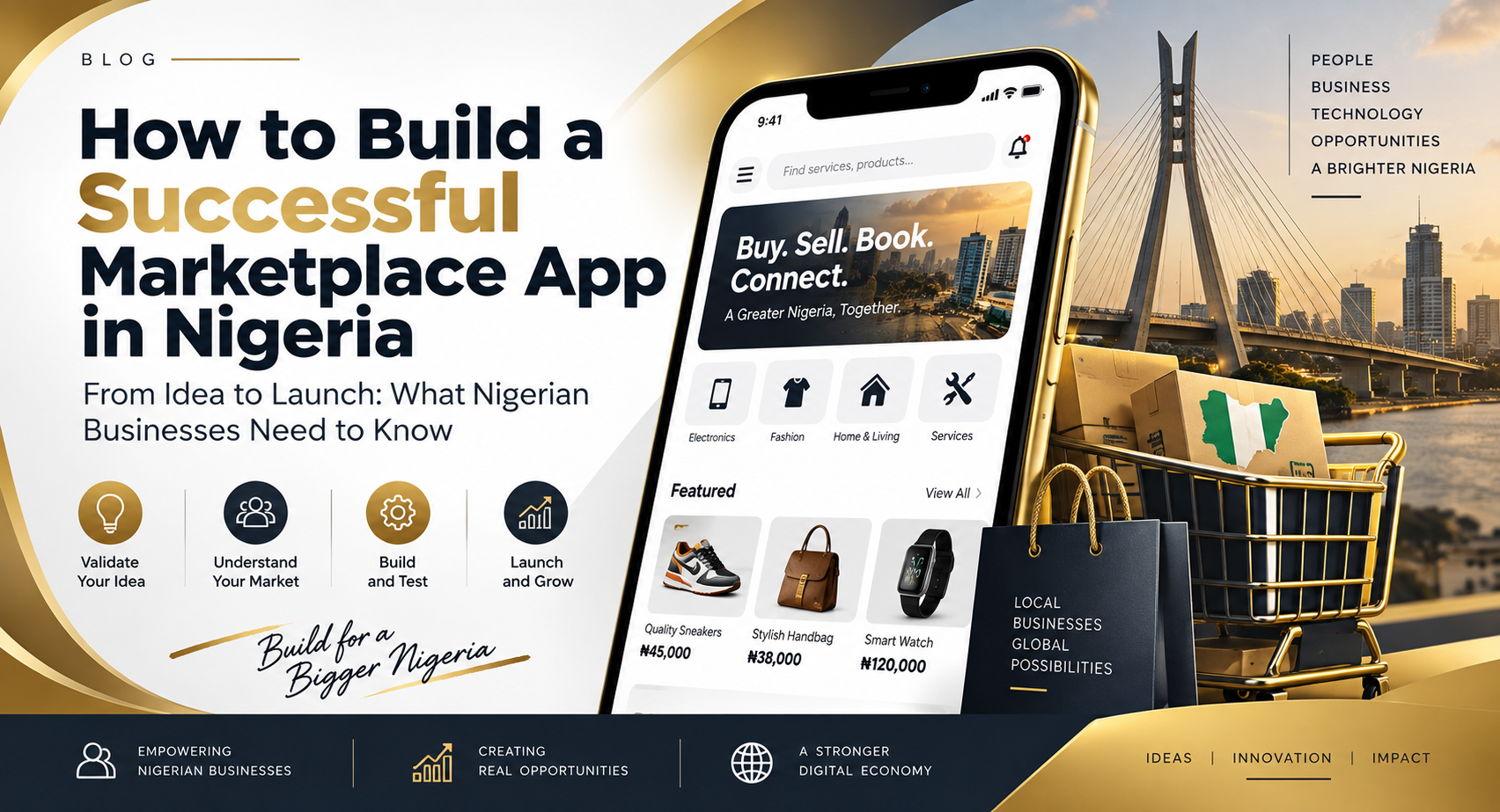
How to Build a Successful Marketplace App in Nigeria From Idea to Launch: What Nigerian Businesses Need to Know
Nigeria’s marketplace economy is changing rapidly. Consumers increasingly discover products and services online, businesses want access to larger markets, and entrepreneurs are looking for technology that can connect buyers and sellers without requiring them to build an entire physical infrastructure. This has created an opportunity for marketplace applications. A marketplace app is more than an online catalogue. It is a digital ecosystem that brings together multiple groups of users, usually buyers and sellers, while providing the technology required to search, compare, communicate, transact, review and manage relationships. For entrepreneurs considering a marketplace application in Nigeria, the biggest question is not simply, “Can we build the app?” The better question is: “Can we build a marketplace that solves a real problem and can operate efficiently at scale?” At KM Consulting & Tech, we approach marketplace development from both the technology and business sides. What Is a Marketplace App? A marketplace app connects independent sellers or service providers with customers. Examples can include: E-commerce marketplaces Artisan marketplaces Food marketplaces Property marketplaces Automotive marketplaces Healthcare marketplaces Professional-service marketplaces Logistics marketplaces Beauty and wellness marketplaces Digital-service marketplaces The marketplace operator provides the infrastructure, while the individual providers supply the products or services. This distinction is important. A normal e-commerce platform may sell products belonging to one business. A marketplace can contain hundreds or thousands of independent vendors. That creates a much more complicated technical environment. The Three Core Users Most successful marketplaces have at least three important user groups. 1. Customers Customers need to be able to: Create an account Search Filter Compare View provider profiles View products or services Make enquiries Book or purchase Make payments Track orders Leave reviews The customer experience needs to be extremely simple. If a customer has to complete ten unnecessary steps before making a booking, conversion can suffer. 2. Vendors Vendors require their own operational environment. Depending on the marketplace, they may need to: Register Complete KYC Create profiles Upload documents Add products Set prices Manage availability Receive bookings Manage orders Communicate with customers Track earnings View transaction history A marketplace is therefore not just a customer application. It is also a business-management platform for vendors. 3. Administrators The administrator controls the ecosystem. The admin dashboard may manage: Users Vendors KYC Products Categories Locations Transactions Reviews Complaints Promotions Subscriptions Notifications Reports Platform settings The admin system is often underestimated during the planning stage. It should not be treated as an afterthought. Location Can Be a Major Feature For a Nigerian marketplace, location can be particularly important. A customer looking for a plumber, electrician, cleaner, mechanic or delivery service may not simply want the highest-rated provider in Nigeria. They may want someone close to them. A location-based marketplace can therefore allow customers to search according to: State City Local government Area Distance Service coverage For example, a customer in Abuja could search for providers operating around Wuse, Gwarinpa, Maitama, Asokoro or other service areas. This creates a more useful marketplace experience. Trust Is One of the Biggest Challenges A marketplace has to solve a trust problem. Customers ask: “Can I trust this vendor?” Vendors ask: “Can I trust this customer?” The platform therefore needs mechanisms that establish credibility. These can include: Identity verification Business verification Phone verification Document verification Ratings Reviews Verified badges Transaction history Provider portfolios Customer support Dispute management KYC should be designed according to the type of marketplace being created and the regulatory requirements applicable to it. Payments Payment architecture is another major consideration. Depending on the business model, a marketplace may require: Direct payment Subscription payment Commission Vendor fees Booking fees Delivery fees Promotional fees The payment flow needs to be clearly defined before development begins. For example: Customer pays → platform records transaction → vendor receives order → platform calculates applicable commission → vendor receives settlement. The exact architecture depends on the business model and payment provider. Don’t Build Everything at Once One of the biggest mistakes entrepreneurs make is attempting to launch every possible feature. A marketplace MVP should focus on the smallest feature set capable of proving the business model. A sensible MVP might include: Customer registration Vendor registration Vendor profiles Search Categories Location Booking/order Payment Notifications Reviews Admin dashboard Advanced features can follow. These might include: AI recommendations Loyalty programmes Advanced analytics Vendor subscriptions Advertising Wallets Referral programmes Automated dispute management Technology Architecture A modern marketplace may use: React or another modern web framework React Native or Flutter for mobile Laravel, Node.js or another backend framework PostgreSQL/MySQL Redis Search infrastructure Cloud storage Payment APIs Notification services Analytics Monitoring The technology should be selected based on the product requirements rather than fashion. What Does It Cost? There is no single price for building a marketplace. The cost depends on: Number of applications Number of user types UI/UX complexity Payment requirements KYC Location services Admin functionality Vendor dashboard Integrations Backend architecture Security requirements Maintenance A simple marketplace MVP can be substantially cheaper than a complex multi-vendor platform with sophisticated financial and operational infrastructure. The right approach is to define the product requirements first and then produce a technical scope and development estimate. Final Thoughts A successful marketplace is not simply an app with sellers and buyers. It is an ecosystem. The technology must make discovery easy, transactions reliable, vendors productive and administration manageable. For Nigerian entrepreneurs, the opportunity is significant—but the strongest marketplace ideas will be those solving specific problems rather than simply copying existing platforms. KM Consulting & Tech helps businesses turn marketplace ideas into structured digital products—from product strategy and UI/UX to web platforms, mobile applications, APIs, dashboards and integrations – +2347039340610

Discover Reasons Why Your Business Needs A Website Asap
In this digital world, your business needs a website to survive the aggressive battle of brands, and now is a good day to have a website where you can easily and effectively promote your business online. You might want to ask why. Good! – just read on and you’ll know the reasons why your business needs a website and why you should have one NOW! As a business owner, it is crucial to position your business online with a credible and smooth destination that provides customers and prospects with the impression to want to subscribe to your product and services using the latest online marketing strategies to engage them – getting a website is one of these strategies! Having this in mind, you should consider these 4 awesome reasons why your business should have a website now. #1. The absence of a business website means losing potential customers: Can you argue this? I don’t think so. A business with a website has a competitive advantage over its competitors even if it’s a small business. Businesses and organizations make huge progress through their website, in terms of brand recognition, sales promotion, awareness, organic traffic, and connecting with potential customers on daily basis. Small businesses with a website can outrank big brands on Google if the right online marketing strategy like search engine optimization is adopted and channel some of their traffic. For this reason, having a website is not a matter of “choice” but a “must” for small businesses who want to have a level ground with the big brand as the case may be. Your website acts as both your office and a salesman who provides every detail about your business or organization. In other words, with your business website, you don’t need to waste your energy talking every time, your website will do the explanation and also provide answers to so many questions that your prospects might have in mind within a few minutes. #2. A business website is budget-friendly: Getting a professional website may be way off your budget; well, so it may seem. That is, creating a professional website could be huge, especially for businesses that are on a tight budget. The good news is that website design agency such as Backdesk tries to maintain a balance in other to accommodate businesses especially small businesses with the flexibility of working with their budget. What this means is that you’ll have the privilege to have a standard business website set up for you as low as N80,000 with Backdesk Innovative Solutions. Get yours Now! # 3. A website gives customers direct access to your business: Let’s be realistic- today we live in a world where most people browse through the internet just before they buy or subscribe to any services. Take, for instance, you own a big salon, and people at the nearby street took a ride to other places, and get the services they want because obviously, they don’t know you’re there. Am sure they might have searched the saloon within the area on the internet and you were nowhere to be found on Search Engine Result Pages (SERPs). The obvious is websites direct prospects to your business as soon as they search for products or services related to your niche. In this digital world, while you sit at the office or store waiting for customers to come and buy your products, there are thousands of people looking for your service or product online but can’t reach you. Instead, Google directs them to your competitors- why? Because they have a website. In other words, it is easier to attract customers to your business through the website. The internet has a wider reach than any other form of advertising that had existed. The web has opened the gate of profit-making for you as a business owner – Use it! #4. A website is cost-effective for businesses If you are a business owner then you are very much aware that businesses and companies spend millions creating fliers and distributing them to both relevant and irrelevant audiences. By having a business website you can do away with such spending entirely. A “part” of the resources or money spent on creating brochures and fliers is too much enough to build an everlasting office for your business on the internet which forms the basis for online marketing where millions of your target market can find you and get converted as a result of the minimalistic and comprehensive nature upon which a premium website is built. With a website, your potential customers can find out about you and your products and service on the internet without passing through any stress and without spending cash locating your business except when it’s necessary. Nevertheless, having a website has become an integral part of every business either large or small scale. Don’t sit back and watch your competitors take all your customers. You should also know that people give more credibility to businesses that have an online presence. Are you interested in creating a quality business website? Contact us for premium website services. Related posts: Top 10 reasons why your website must be mobile-friendly How to check if your website is mobile-friendly
10 Marketing Ideas for Every Startup in Nigeria
Want to increase your Return On Investment (ROI)? These 10 actionable marketing ideas for small businesses will help you get customers and increase sales in Nigeria – You don’t have to spend a fortune. Creative marketing strategy is the key to success, especially for small businesses in Nigeria. In fact, leveraging the right marketing ideas and strategies can sometimes make an average product outshine a better product that is poorly managed and marketed. Big businesses like Coca-cola, MTN, Glo, etc can dedicate a lot of resources both monetary and staff to get their business noticed and marketed to its intended audience. On the contrary, as a small business, you don’t have such luxury. The question is, how can you meet up and stand a chance with these big brands in order to make ends meet for your business and attract more sales in Nigeria? Simple! You don’t have to spend a fortune on business marketing like the big brands. But you can achieve greater results like them by leveraging and keeping up with the trending marketing strategies you haven’t ventured into yet. Ready to make more sales and increase your income?. Pay close attention to these 10 marketing ideas and then adapt to working marketing techniques for your small business. Table of Contents 1. Project the Uniqueness of your Business 2. Engage in Affiliate Marketing with related businesses 3. Segment your specific target audience 4. Expand your target markets 5. Build Customer relationship 6. Leverage Social Media Marketing 7. Get a Website 8. Getting listed on Google My Business and other online business directories in Nigeria 9. Start Email Marketing to reach your target customers 10. Embrace Content Marketing 1. Project the Uniqueness of your Business What makes something/somebody extraordinary is “extra effort”. To be extraordinary is to be unique – adding more effort to what others are already doing and then adding more flavor to yours. In other to succeed as a small business in Nigeria, you should take your time to analyze the big brands (Big players in your line of business) and find something that differentiates you from your competitors. Then inject your strength to promote the uniqueness of your business. When you market your small business by projecting its uniqueness, you stand out. Your Unique Selling Point (USP) could be anything – find out what it is your competitors lack and project it before your target audience. 2. Engage in Affiliate Marketing with related businesses As a small business, if you want to meet up and grow more revenue, there are a couple of ways to go about it. You can engage related businesses that reach your specific target market and find a way to collaborate with them. Affiliate marketing works perfectly well for small businesses because it’s a win-win game, do this for me in return you will get this. So it doesn’t matter if you actively market each other’s services. The bottom line is to boost your brand credibility and build a firm background for your business and most importantly generate more sales. Similarly, you can partner with other small businesses and influencers in your industry. 3. Segment your specific target audience Every business has a specific target audience. As a business owner especially a startup, you must streamline your target audience and create products and services or provide solutions that specifically appeal to the needs of each target market. You need to understand the language of the different segments of your audience before marketing to them. The older ones may prefer a more formal tone, while the youths may prefer something trendy. 4. Expand your target markets Take for instance if you are into catering services. You can sell your products to local businesses that need such services in your area as well as market directly to consumers. This will go a long way toward marketing your business and creating more awareness for the product you offer. Don’t limit yourself to only small businesses, you can as well engage in soliciting business deals from bigger companies, including government agencies, (from federal to local government) as long as what you offer appeals to their needs. 5. Build Customer relationship A good customer relationship rekindles success in business. Most businesses especially startups focus more on getting new customers. That’s great! but a good business will do everything possible to retain the existing customers. With existing customers, you have a great chance of getting referrals from them. As a small business, you should build a lasting relationship with your customers. One thing to note when marketing your small business in Nigeria is that customer relationship is important. Most customers return to purchase your product because of the way they feel about your brand. Engage them with relevant information and updates about your products and services – ask them for feedback. Ask them the best way you can serve their needs better and do well to implement the ideas if they’re worth trying. The bottom line is, to build and retain your customers while you seek new leads. 6. Leverage Social Media Marketing Social media has become one of the most effective and reliable means of marketing in this 21st century and any business yet to leverage this trend is losing out big time. So as a small business, you should leverage social media marketing if you haven’t already done so. This is one of the cheapest methods to market your small business. Create and engage your business in the most appropriate social media platforms that would engage your target audience such as Facebook, LinkedIn, Instagram, Twitter, etc. Find out the most suitable platforms that will best appeal to your customer and run maximum promotions to boost and create awareness for your business. Be sure to update and fill out social media business page profiles with as much detail as you can, being sure to include website links and products. Talking about a website, every business needs a website. So – 7. Get a Website I choose to introduce a website on the 7th list because any business that doesn’t understand the aforementioned ideas
6 Proven Strategies That Will Boost Your Sales Today
Without leads, your business is a sure failure. Can you argue that? Smiles- I bet you won’t. Differentiating traffic from lead generation is usually misunderstood by most people. For a good understanding of this post, let’s concisely explain what lead generation is all about. While traffic generation is geared towards bringing more visitors to your website, lead generation focuses on turning or rather converting these visitors into potential customers. Leads are quality potential customers who can become ideal customers and your brand loyalists, only if you approach them with the right strategy. By definition, lead generation is a way of attracting prospects to your business/website through special yet common ways to appeal to and convince them to actually make a buying decision and become full-fledged customers. In this post, I will walk you through the best tips that if well implemented will help you generate more leads to your business through your website. #1. Optimize Your Website Messaging Charity they say begins at home A website can be likened to a salesman in a shop, what he does is sell a product to prospects using the most effective means that will convert the prospect into paying the customer. Ever come across a website where you read every word and navigated through the visual representation on the homepage yet you seem lost – not sure of what the business is all about? It’s a bad user experience. I don’t think you want your site visitors to experience such. As a start-up, your customers should be able to get a comprehensive knowledge of what your business is all about at first glance. It should be able to define what services or products your business offer. the truth is, most businesses or organizations may have spent a lot of time and energy building a beautiful website but then neglecting the vital component that would determine both their conversion and bounce rate – Website Messaging. As a business owner striving for brand awareness and credibility to generate a lead for his business, you should understand that it will be a big blunder if after spending your resources developing a nice website yet it doesn’t really translate the exact products and services your business offers. So what do you do? Simple! – Optimize your website information. It is one thing to communicate and another to communicate effectively. Effective communication gives meaning to the stories you’re trying to sell to your audience. Note: Communicating the meaning and value of your business through your website to an audience is one thing every small business should integrate to generate more leads and possibly convert these leads to actual paying customers. Do this right and enjoy the huge benefits. The second thing you should consider is your site load speed. 2. Have a responsive and speed-loading website How responsive is your website? How long does it take for your website to load? These are just a few question business owners should answer. Let me remind you that website visitors are impatient and very quick to judge. According to Tony Haile, CEO of Chartbeat, “an average reader will stay on your page for just 15 seconds. So you have just a limited time to either retain visitors on your website or have them bounce off. Poor responsive and low loading website will increase the bounce rate on your website. If your website loads forever, then you have a big problem because visitors won’t even get to learn about the services your business offer. To avoid this, consider optimizing your web page content for a better user experience. This is just one out of many strategies you can use to generate more leads to your business. The next on the list is blogging. 3. Start Blogging to increase your SEO rankings Blogging gives you added the advantage of connecting your business with your website visitors. This can be achieved by telling readers to add their opinion in the comment section at the end of the blog post, with this, you get to meet, interact, and rapport with your audience. You can also gain a meaningful idea of what services or products your customers/prospects may be searching for. There are numerous ways of generating traffic and leading to a website, and blogging is one of the fundamental strategies to achieve that. Most businesses have leveraged the power of blogging as a way of generating leads for their business simply because blogging works. However, blogging does not only drive traffic to your website, it equally increases your SEO rankings, making your business even more visible to people looking for your services online. Embrace content marketing, it really pays. 4. Leverage call tracking strategy to generate more leads As part of lead generation strategy, call tracking is very effective to getting potential customers While I was doing my research, I found out that most businesses have the idea of call tracking but don’t really know how to affect these strategies. This leads us to the question of how to go about generating a lead through call tracking. Here is the thing – Your site visitors want to interact with a human being especially when it comes to making their buying decision which automatically translates to huge sales and profit-making for your business So to generate more leads for your business, call tracking helps you analyze and know how your clients reach you. It might be from ads on your website or social media campaigns. The point is, call tracking will help you know and determine where your money is best spent. With this kind of insight about your campaigns, you should be able to streamline your marketing strategy and then consider investing more in the campaign where you have more conversions. Want to generate more leads for your business? Leverage call tracking strategy. 5. Use Active Online Chat Literally, every company has an online chat option, but the big question is, how many of these companies online chat but is active? The truth is, most companies/agencies, organizations and businesses just include the